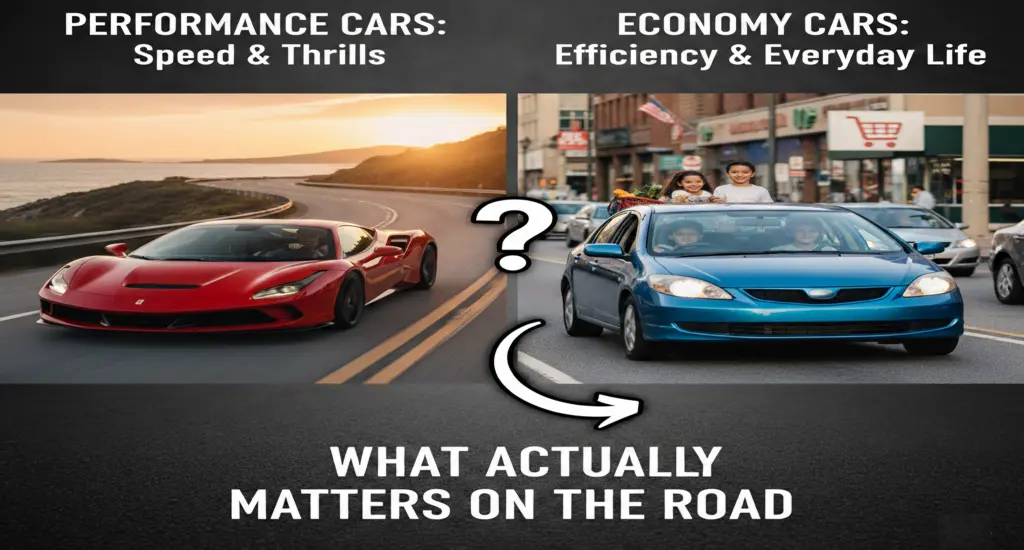

The car culture in the United Arab Emirates is a wonderland of high-end engineering masterpieces and practical, everyday vehicles. On any given day you can find the high-powered supercar and dependable economy hatchbacks sharing road lanes. This level of choice can often make potential buyers wonder exactly what it is they need from their next car.
Marketing is too often about speeds reached or fuel saving gained in isolation. Yet the day-to-day reality of driving is a strange combination of heat, traffic and road surfaces. When it comes to performance vs economy cars, you’ll need to consider your options carefully and do your own research.
It’s all about how a car fits into your life and your finances. For some, the excitement of grappling with more power rivals the additional cost. For other people, the closest thing to ultimate luxury is the reassurance that their running costs will be low.
How Most People Actually Drive on UAE Roads
In order to make a rational choice we have to analyse first the surroundings. The reason why it is so different to drive in the UAE is because of the well-developed roads and the manner in which the locust traffic moves around. There are two types of scenarios where most drivers spend the majority of their time.
During rush hour, the first is the snail pace of urban traffic. The second is the multi-lane highway tempo racing between emirates. The two scenarios (city and highway driving) are about vehicle and driver demands.
A car that performs well on a road trip may be infuriating in a traffic jam. A city car could also be uneasy on the highway at higher speeds. Knowing the type of driver, you are is the first step in finding the perfect car for you.
City Traffic, Highways, and Weekend Driving Reality
Inorganically like traffic in the cities of Dubai or Abu Dhabi you have to stop and go a lot. Here a quick gearbox and good visibility trump horsepower. You want to a car that is easy to drive, maneuver, and park in small spaces.
Also on the highways, comfort and quietness are critical. For continuous speed (120 km/h or 140 km/h) you need a car that feels stable. Warm winds and sun can be detrimental to the lighter economy cars more so than the heavier performance vehicles.
Weekend driving is just as likely to be family trips or leisure activities. This calls for room and comfort for passengers. The car should make for a good grocery run, a hectic day at the airport and a school field trip.
What Performance Cars Offer Beyond Speed
The truth is, for most performance cars, the playing field is much higher. Speed is one consideration, but the engineering differs considerably. Performance vehicles are engineered to talk to the driver.
You can experience a level of feedback through the steering wheel and seat that is often missing with economy cars. This linkage allows the driver to feel grip and road texture. Instead of a chore, driving becomes a passionate pursuit.
Safety, too, is a benefit of performance engineering. Large brakes and sticky tyres are meant to stop the car numerous times from a high speed. This feature is a major safety advantage in emergencies.
Acceleration, Handling, and Driver Engagement
Racing off from the lights is not the only thing acceleration is good for. It makes for safe merging on to moving traffic on highways. When you have power in reserve, you have options when negotiating crazy traffic conditions.
It includes the car’s response to turning the wheel. It steers with instantaneous direction changes and flatness in the corners. This accuracy enables you to position the car precisely on the road.
Driver engagement is the emotional return on your investment. It is the pleasure of a good gear change, or a well-timed corner. For enthusiasts, the feeling validates the steep price tag.
What Economy Cars Prioritise in Daily Use
Economy cars are efficiency and packaging wonders. They exist simply to get people from point A to point B with as little fuss and expense as possible. Every element is engineered to be long-lasting and cost-effective.
Its emphasis is on fuel economy and reliability. Petrol sipping engines are tuned and efficiency cranked up in the transmissions. The upshot is on the day to day incredibly cheap to run car.
Comfort is also an aim, achieved at least in part by using softer suspension settings. These are cars that are built to take speed bumps, potholes and everything else you can throw at them. They provide a smooth drive that remote the driver from the road.
Fuel Efficiency, Comfort, and Low Running Costs
Fuel efficiency, of course, is a big financial consideration for the average commuter. Economy cars, on the other hand, can move twice as far on the same amount of fuel as a performance car. When you’re commuting a year, this saving can rack up.
In addition, maintenance is far less expensive. Parts are produced in large quantities, and are readily available. Brakes and tires are smaller and cheaper to replace too.
The economy segment has always been the embodiment of reliability. These cars are made to be neglected and abused. They’re the sensible option if you think of a car as a tool.
Ride Comfort and Handling in Real World Conditions
Ride comfort is a matter of taste and expectation. Performance cars are equipped with stiffer suspension to minimize body roll. This means you get excellent handling but the ride can be a bit busy or harsh over rough terrain.
Economy cars have softer springs and are better at absorbing bumps. However, this will also create a “floating” feeling when you drive fast. It is possible that the car leans more on corners, in which case that could be discomforting for some passengers.
The trick is to come somewhere in the middle of these two extremes. Many modern cars try to bridge this gap with adjustable suspension. But the essential nature of the car is usually to be this, or that, in terms of vehicle dynamics.
Which Feels Better on UAE Roads
The state of your tyres will greatly affect the quality of your ride. Performance cars are fitted with low profile tyres that tend to transmit more road noise. Economy car tyres have higher sidewalls to provide this extra layer of protection.
Tyre maintenance, whether in your car or a different model, is necessary for a comfortable ride – regardless of the type of vehicle you drive. Car owners look for car tyres offers in dubai to buy high quality tires that fit their specific vehicles and budgets. Selecting the appropriate tyre size can also enhance the ride comfort of a sports car and handling of a regular car.
So in the end “better” is really up to you. Go performance, if you want to feel the road. Get economy, if you want to float over it.
Fuel Consumption and Ownership Costs Over Time
The initial acquisition cost is only the tip of the iceberg. The overall ownership cost covers depreciation, insurance, and maintenance. Performance cars tend to depreciate in value more quickly than an economy popular car.
Premiums for high-performance cars are more expensive because of the risk.”. Some registration fees may also fluctuate a bit. These expenses are annual, and spend your money every year and not once.
Fuel efficiency is the most visible daily cost. High-performance engines need premium fuel and consume more of it. Value engines use regular and are economical.
Daily Costs That Matter More Than Horsepower
Serving a high performance car requires nerve and precious fluids. Oil changes cost as much as three times as much as an economy car does. Brake rotors and pads are larger and more expensive.
Tyres on performance cars are wider and softer compounds are used. This means they wear out faster and are costlier to replace. Perhaps you will be changing them every 30,000 km rather than 60,000km.
Repairs for performance cars also tend to be more expensive Unexpected repairs can also be pricier on performance cars. Intricate machinery such as turbochargers or dual clutch transmissions are costly to repair. While economy cars are simple and cheap to fix.
Safety and Driving Confidence Comparison
Both types of cars are safer than they have ever been. Strong crash structures and multi-airbag systems are mandatory nowadays. Nevertheless, they have different philosophies when it comes to avoiding accidents.
Active safety is what performance cars are about. Better braking and handling help drivers steer around things in the road. They also give you the control you need to safely recover from a skid or swerve.
The focus for economy cars is passive safety and driver assistance technologies. Lane keep assist and automatic braking, among other features, are now standard. They try to make up for the deficiencies in the handling of the car.
Control, Stability, and Driver Awareness
Good stability at speed is a great confidence maker. Performance cars are solid and planted on the highway. This cuts driver fatigue when making the long road trips across emirates.
Steering feedback in sports cars informs the driver of the level of grip. You can feel yourself going too far. Economy cars have a tendency to feature numb handling that masks this information.
Consistency of braking is crucial in the heat of the UAE. High-performance brakes fade less than standard brakes. This guarantees reliable stopping power even in stop-and-go traffic or after a sudden stop from a very high speed.
Which Type of Car Fits Different Driver Lifestyles
Performance car is a great pick for a young professional with no dependents. It injects a little thrill into the daily grind and complements the appearance of having made it. The higher prices are usually affordable and worth the ride.
Families tend to lean toward economy SUVs or sedans. The space, comfort and security match the priorities of parents. You can also enjoy lower running costs to help with other family expenses.
Long distance commuters enjoy the economy of economy cars. Just think, those fuel savings could pay for a vacation. Also, the bobtail suspension is a bit more relaxed for a smoother ride, which helps alleviate back pain!
Car nuts will always pick performance, cost be damned. For them, these cars are hobby and passion. Driving the car is the main aim, not just being driven.
FAQ Section
Are performance cars practical for daily driving?
They can be, but they run differently and have different costs and comfort levels.
Do economy cars feel underpowered on highways?
With a few exceptions, modern economy cars are great for highway driving.
Which is better for UAE traffic conditions?
Economy cars tend to perform better for everyday city traffic.
Does tyre choice affect both car types equally?
Yes, tyres have a huge part to play in comfort and control.
Conclusion
In the conclusion of this automobile blog, There’s no right or wrong answer in the performance vs. economy car debate. It is deciding whether the vehicle capabilities fit your reality. Both types of vehicles are suitable for in UAE roads.
Performance Cars Enable You to Drive Your Sports Car with Precision, and Behind the Wheel, You Can Feel Your Car’s Security on the Road. These are the cars that convert a routine drive into an occasion. But they require a bigger investment and a little compromise on comfort.
By their very nature economic cars allow you to have stress free mobility, to have access to financial freedom and have a practical vehicle for your everyday life and beyond. They are instruments intended to serve you well. No thrill, but always on their promises.
When you have a chance, take each for a spin on the roads you travel most. See and feel the difference in traffic, on the highway. The right decision is the one that makes you smile, whether you’re in the driver’s seat or the bank.