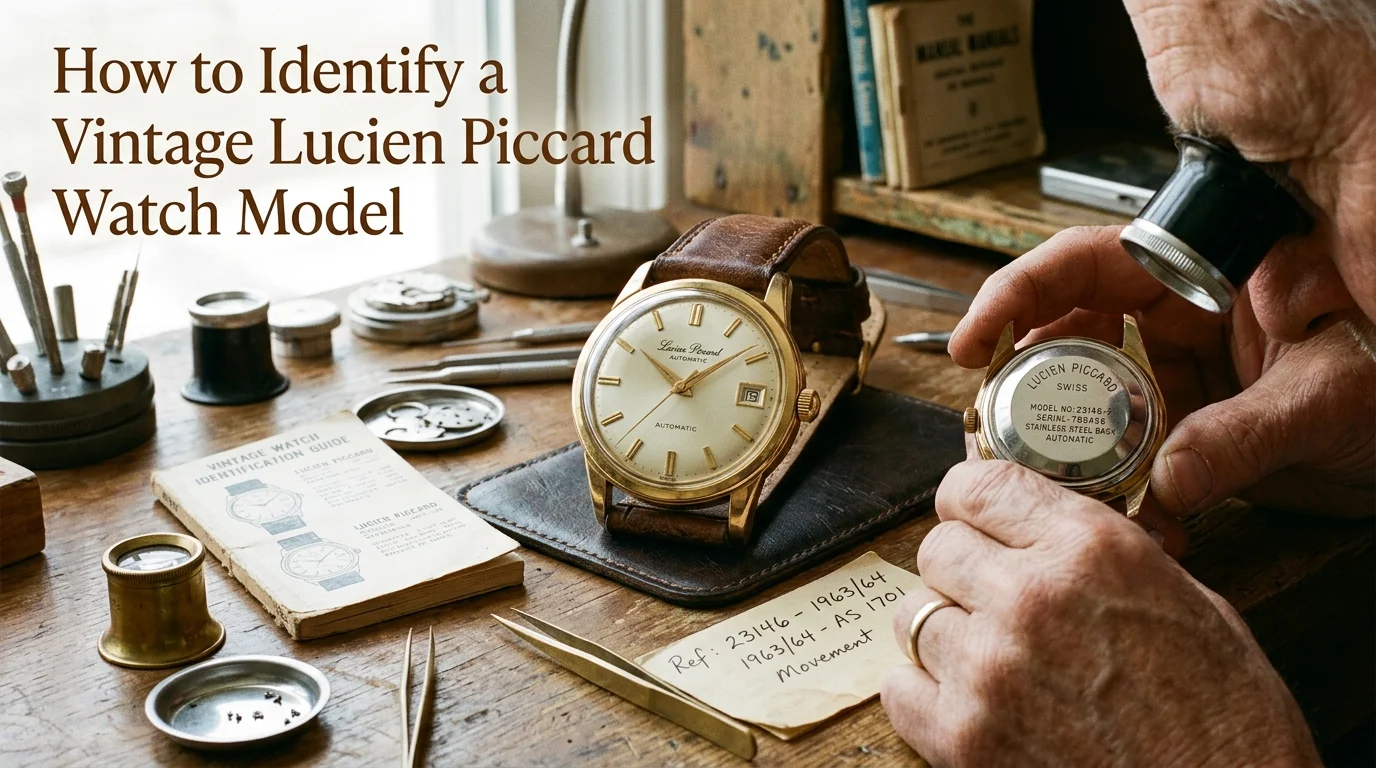
If you\’ve discovered an antique watch at an estate sale or received one as a family heirloom, you might possess a Lucien Piccard watch. The Swiss watch brand started in 1923, which makes its vintage timepieces highly sought after by collectors. The process of determining the precise watch model becomes challenging because of these particular circumstances. Vintage watches need research work because their model identification lacks the direct ways of modern timepieces, which show their model numbers and available documentation. The good news? The process becomes simpler when you understand the necessary elements to identify.
Check the Case Back First
The first step requires you to turn the watch face down. The case back section contains the most critical evidence, which needs to be uncovered. Lucien Piccard timepieces display engravings or stampings that show their serial numbers and reference numbers and the \”Swiss\” or \”Swiss Made\” label. The presence of metal purity marks on the item allows you to see 14K and 18K and stainless steel.
The numbers need careful inspection because they can appear extremely small. The numbers sometimes appear as a circular pattern that surrounds the perimeter of the case back. The numbers appear in the central section of the design. Write down every number and marking you see. These markings will become essential during your upcoming research work.
Some vintage watch models feature case backs that attach through a snap mechanism, while other models use a screw-down system. The case back can be opened by you when you feel ready to inspect the watch movement. The process requires you to maintain caution. You should let a technician handle this task because you lack experience with watches.
Examine the Lucien Piccard Watch Dial
The watch dial presents valuable information about your timepiece. The brand name appearance needs you to start examining it. Older models typically display the name \”Lucien Piccard\” through an elegant script writing style. The models display \”Lucien Piccard Seashark,\” which includes additional model names such as \”Dufonte\” and \”Galaxie.\”
The dial color requires you to observe all decorative patterns. Vintage Lucien Piccard timepieces came in various styles: sunburst finishes, textured patterns, or simple, clean dials. The designs used applied gold markers for some watches, while others opted for printed indices.
Check whether the dial features a date display window. If the window exists, please indicate where it is located. Is it positioned at 3 o\’clock, 6 o\’clock, or another location? This information narrows down which watch model you have and when it was made.
The hands need your examination. Do they have a dolphin shape or stick shape or sword shape? The watch should have original hands that match its design. The presence of new hands indicates that the watch has undergone maintenance and alterations since its original state.
Study the Case Shape and Size
Vintage Lucien Piccard watches came in many shapes. The most common case design features round cases, although you can also discover tonneau (barrel-shaped), cushion, and rectangular cases. You can use the shape of the object as a tool to identify both its time period and its specific product range.
The case diameter measurement should exclude the crown element. Vintage men\’s watches typically had a size range of 32mm to 38mm during earlier periods. The current fashion standards consider this range to be small. Women\’s watch sizes typically fell between 20mm and 28mm during that era.
The case material matters too. The 1960s and 1970s developed a trend for gold-filled cases. Solid gold cases indicate a higher-end model. The Seashark collection features sporty design styles that use stainless steel as their primary material.
Examine the lugs, which function as the points where the strap connects to the watch. The lugs possess straight lines, curved lines, or special designs. The design of the lugs establishes a unique appearance that connects directly to particular watch models.
Research the Movement
The movement offers essential details, which you can discover through your access. Lucien Piccard produced watches using their own in-house engine development while also purchasing Swiss watch movements from companies such as ETA, AS (Adolf Schild), and Peseux.
All components of the movement need to have their caliber numbers permanently marked throughout the design. The numbers serve to establish identification. You can find matching models by using online databases that connect with vintage watch forums to search for specific caliber numbers.
The vintage Lucien Piccard automatic movements feature the \”GP\” marking on some of their components. The mark stands for Girard-Perregaux because both companies had a business relationship that lasted for multiple time periods.
The 1960s onward brought a shift from manual wind movements to automatic movements, which gained wider popularity.
Use Online Resources and Communities
The time has come for research after you complete the information-gathering process. Vintage watch forums are goldmines of information. WatchUSeek and Reddit\’s watch community provide collectors who have evaluated numerous Lucien Piccard models with valuable insights.
The watch requires multiple clear photos that display its front and back and side view and movement, if accessible. Include all the numbers and markings you found. The community can often identify your model within hours.
Search eBay\’s sold listings too. Filter for \”sold items\” and search for Lucien Piccard timepieces that look similar to yours. This process enables you to discover the official name of your model along with its estimated market value.
Vintage watch catalogs and advertisements are additional resources that provide useful information. Some collectors have archived old Lucien Piccard catalogs online. These documents display the original models together with their official product names and detailed specifications.
Consider Professional Authentication
If you believe your watch might be particularly valuable or rare, consider getting a professional assessment. A certified watchmaker or appraiser can confirm authenticity, identify the exact model, and assess condition.
They can spot things you might miss: replaced parts, refinished dials, or frankenwatches (watches assembled from parts of different models). The watch value depends on these elements because they have a major influence on how much money the item can sell for.
The process of professional authentication becomes essential when you need to sell your watch or obtain insurance for it. Documentation from a recognized expert adds credibility and peace of mind.
Final Thoughts
The process of recognizing a vintage Lucien Piccard watch requires both persistence and thorough research work, which people can successfully complete. Begin your investigation by examining the case back and dial markings and then record every detail about the case and movement before you use online resources and collector communities. Your discoveries bring you closer to revealing everything about your possessions. The process of discovering what your watch embodies becomes a vital aspect of the experience in vintage watch collecting. Take your time, document everything, and enjoy learning about your timepiece\’s history.